

Autor: KANT. (Immanuel)
Idioma: Francês / French
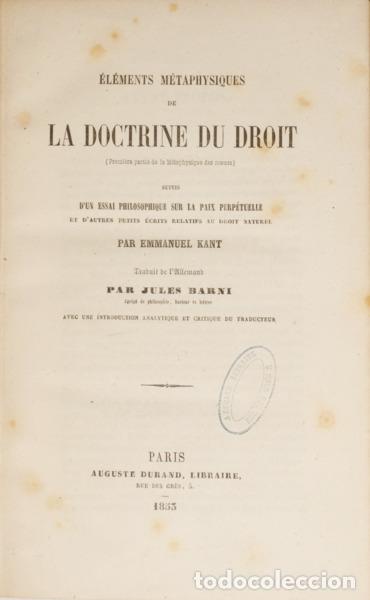
(Première partie de la Métaphysique des moeurs). Suivis dun Essai Philosophique sur la Paix Perpétuelle, et dautres petits écrits ralatifs au droit naturel. Par Emmanuel Kant. Traduit de lallemand par Jules Barni, agrégé de philosophia, Docteur ès lettres. Avec une introduction analytique et critique du traducteur. Auguste Durand, Libraire. Paris. 1853.
De 22x15 cm. Com iii, [i], iv, cxci, [i em br], 392 págs. Encadernação com lombada em tela e ferros a ouro. Pastas em papel marmoreado. preserva as capas de brochura.
Exemplar com assinatura de posse coeva na capa de brochura anterior, alguns picos de humidade no corte das folhas, páginas preliminares e finais, carimbo oleográfico do editor na folha de rosto e sublinhados a lápis.
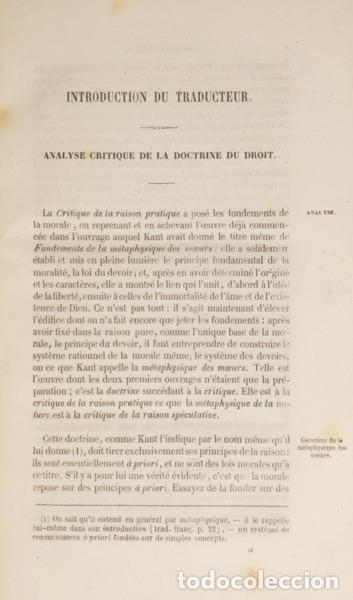
Contém em face da folha de rosto uma lista das obras do autor. As primeiras iv páginas preliminares com um prefácio, e uma extensa introdução do tradutor em que faz uma análise critica da doutrina do direito, nas cxci páginas. O índice encontra-se nas últimas páginas. Inclui notas marginais e de rodapé.
A obra inclui um prefácio em que contém introdução à metafísica da moral e a doutrina do direito, onde inclui um apêndice à introdução da ciência do direito, e divisões da doutrina do direito e da metafísica da moral em geral. Constituída por capítulos e sessões divididos em duas partes, primeira sobre o direito privado e a segunda sobre o direito público. Inclui ainda no fim da obra alguns ensaios sobre o direito de autores como G. Hufeland e A. M. Nicolai.
Os Éléments métaphysiques de la doctrine du droit constituem a primeira parte da obra fundamental de Immanuel Kant, a Metafísica dos Costumes.
Neste texto, Kant procura estabelecer os princípios racionais e a priori que fundamentam o direito, independentemente da experiência ou das leis positivas de um Estado específico.
A obra divide-se geralmente em duas grandes secções: o Direito Privado e o Direito Público. Para Kant, o Direito é o conjunto de condições sob as quais o arbítrio de um pode coexistir com o arbítrio de outro, segundo uma lei universal de liberdade.
Direito Privado: Foca-se na posse e na propriedade. Kant analisa como é possível adquirir algo exterior como seu (objetos, contratos, relações familiares) de forma legítima perante a razão.
Direito Público: Trata das leis num estado civil. Divide-se em: Direito do Estado: Organização interna e separação de poderes; Direito das Gentes: Relações entre Estados e Direito Cosmopolita: Direito de hospitalidade universal.
Embora Direito e Moral pertençam ambos à Metafísica dos Costumes, o Direito foca-se na legislação externa (ações e deveres que podem ser coagidos), enquanto a Ética (Doutrina da Virtude) foca-se na legislação interna (motivações e deveres para consigo mesmo).
Immanuel Kant (17241804) foi um filósofo prussiano central para o Iluminismo e um dos pensadores mais influentes da história ocidental. Passou toda a sua vida em Königsberg (hoje Kaliningrado), onde foi professor na universidade local, mantendo uma rotina extremamente metódica e dedicada ao estudo. A sua obra divide-se entre o período pré-crítico e o período crítico, inaugurado com a Crítica da Razão Pura, onde operou uma 'revolução copernicana' na filosofia ao investigar os limites do conhecimento humano. Além da epistemologia, Kant revolucionou a ética com o conceito do imperativo categórico.
[EN] 22×15 cm. iii, [i], iv, cxci, [i blank], 392 pp. Bound with a gilt tooled canvas spine. Marbled endpapers. Paperback covers are preserved.
Copy with contemporary handwritten ownership title on the front of the earlier paperback cover; some damp stains along the edges, on the flyleaves and endpapers. Publishers lithographic oil stamp on the title page and pencil underlining.
The frontispiece backside contains a list of the authors works. The first 4 pages comprise a preface and an extensive introduction by the translator, in which he offers a critical analysis of legal doctrine, spanning 191 pages. The table of contents is found in the final pages. It includes marginal and footnotes.
The work includes a preface containing an introduction to the metaphysics of morality and the doctrine of law, which features an appendix on the introduction to the science of law, as well as an overview of the doctrine of law and the metaphysics of morality in general. It is organised into chapters and sections divided into two parts: the first on private law and the second on public law. It also includes, at the end of the work, a number of essays on law by authors such as G. Hufeland and A. M. Nicolai.
The Metaphysical Elements of the Doctrine of Law form the first part of Immanuel Kants seminal work, The Metaphysics of Morals.
In this text, Kant seeks to establish the rational and a priori principles that underpin the law, independently of experience or the positive laws of any particular state.
The work is generally divided into two main sections: private law and public law. For Kant, law is the set of conditions under which the free will of one person can coexist with the free will of another, in accordance with a universal law of freedom.
Private Law: Focuses on possession and ownership. Kant examines how it is possible to legitimately acquire something external as ones own (objects, contracts, family relationships) in accordance with reason.
Public Law: Deals with the laws of a civil state. It is divided into: State Law: Internal organisation and the separation of powers; International Law: Relations between states; and Cosmopolitan Law: The right of universal hospitality.
Although Law and Morality both fall within the Metaphysics of Morals, Law focuses on external legislation (actions and duties that can be enforced), whilst Ethics (the Doctrine of Virtue) focuses on internal legislation (motives and duties towards oneself).
Immanuel Kant (17241804) was a Prussian philosopher central to the Enlightenment and one of the most influential thinkers in Western history. He spent his entire life in Königsberg (now Kaliningrad), where he was a professor at the local university, maintaining an extremely methodical routine devoted to study. His work is divided into the pre-critical and critical periods, the latter beginning with the Critique of Pure Reason, in which he brought about a Copernican revolution in philosophy by investigating the limits of human knowledge. In addition to epistemology, Kant revolutionised ethics with the concept of the categorical imperative, and laid the foundations of modern law and German idealism, arguing that the autonomy of reason is the basis of human dignity.


Portugal (Lisboa)
Mehr Artikel von Kant


 Español
 English
 Deutsch
 Français
 Português
 Italiano